5/1//2024: One-Legged Balance, Again
Again this week, I’m revisiting a topic I wrote about in a previous newsletter – one-legged balance. Here’s some of what I wrote last July:
One-legged balance builds mental focus and physical endurance. Your ability to balance is also an important indicator of your ability to avoid and recover from falls. (I’d be happy to share more with you about some really good scientific studies of balance!)
In exercise talk, the holding of a one-legged position is isometric engagement or time under tension. And it’s also useful to be able to accomplish dynamic (body in motion) physical tasks while standing on one leg.
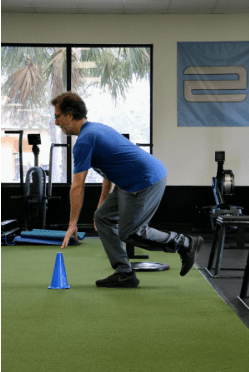
That’s all still solid information. I’ll add that in yoga, we’re often holding one-legged postures (Tree, Warrior 3, Half Moon) as a way of practicing mental focus. In a workout, the balance movements usually involve doing something while standing on one leg (like swinging ropes, one of my recent favorites) or moving in and out of the one-legged position like I’m doing in the photo (one-legged squat, reaching for a target). And as many of you have heard me say many times, one-legged balance is something we can and should practice at least several times a week – or every day!
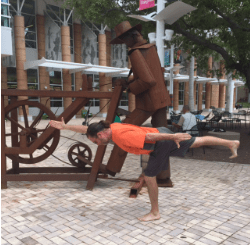
As I put together these newsletters, it’s fun to go through my many files of photos. In the one below, I’m doing Warrior 3 in front of the Fort Myers Library downtown. Back then, my one-legged balance practice was almost always holding a yoga posture. (And one of these days, maybe I’ll write about all the interesting and unusual places I’ve taught yoga over the last 10 years.)
My latest workout option for you, 2 Fit Lunch Break, has been a lot of fun! It’s Tuesdays and Thursdays noon-12:45, cost is $15. It’s invigorating and challenging, and it won’t wipe you out for the rest of your day. Circuit training, cardio, strength, yoga, and some things on one leg (of course!). I’d love to see you there, and if you’ve already given it a try, thanks!
5/13/2024: Get Up (and Down)!
A couple of weeks ago, I wrote (again) about the importance of squats. The main reason it’s such a vital movement is that it works the body in the same way as getting up and down to and from a seat.
Ideally, we want to be able to get up and down, to and from a seat and the ground, on our own for as long as we can. And in our daily lives, often we use support to make those moves. So practicing unassisted (or minimally assisted) up-and-downs now is insurance for your independence in the future.
I’ve included today a few of my go-to practice moves. The first is from standing to your knees and back to standing. You can certainly practice it next to a wall, or holding onto something – the idea is to be as hands-free as possible.
The second is from a cross-legged seat to standing. (Actually, sitting cross-legged itself is a worthwhile practice.) And if you have to touch the ground a time or two, that’s just fine.
The third (and these are progressing in terms of challenge) is from standing to cross-legged and back to standing. I can only do this on one side, and as you can see, I’m pretty wobbly!
And the final one, the Turkish Get-Up, uses a hand on the ground. But you keep an arm overhead the whole time, and eventually get to a point where you can hold some weight (dumbbell or kettlebell) overhead. This one, and the one in the first video, are regular parts of my workouts.
There are so many other cool ways to practice your up-and-down/down-and-up independence – I’d love to show them to you in person, which would be the best way to practice and learn them!
 Fitness With Chip